Luca wrote a report for Catharina Halkes Fund’s website in dutch. Here is a translation!
With the help of the fellowship grant awarded by the Catharina Halkes Fund, I engaged in the final phase of fieldwork in Senegal and Chad from January through March 2026. Additionally, in June 2026, I completed the ethnographic film Errands for Love (Ruwahha li-lmahhaba), in collaboration with filmmaker Jilles van Kleef. This film is now ready for screening at (visual anthropological) film festivals, universities, and for interested parties.
Themes
Religious exchanges are the subject of my doctoral project at Leiden University. The analytical focus lies on gender, networks of Muslims and Fulani, and the connections arising from the use of social media in Chad. This study aims to map the nodes in ‘Muslim networks’. By focusing on women with diverse educational, hierarchical, and socioeconomic backgrounds, a coherent picture emerges of how Muslim communities in Central Africa are organized. I focus specifically on khalāwi and zawyāt—Quranic schools and places where Muslims gather—as central connecting points in the formation of religious support networks. In these places, a diverse population of women practices Tijaniyya knowledge (an originally Algerian Sufi order). The growth of women-run Quranic schools in Chad is part of a trend occurring widely in the Sahel. Contributing factors include urbanization, the designation of women as legitimate Islamic leaders by Senegalese scholar Sheikh Ibrahim Niasse and the popularization of his discourse since the 1960s, training programs for female religious leaders, and the global and local visibility of Muslim women online.
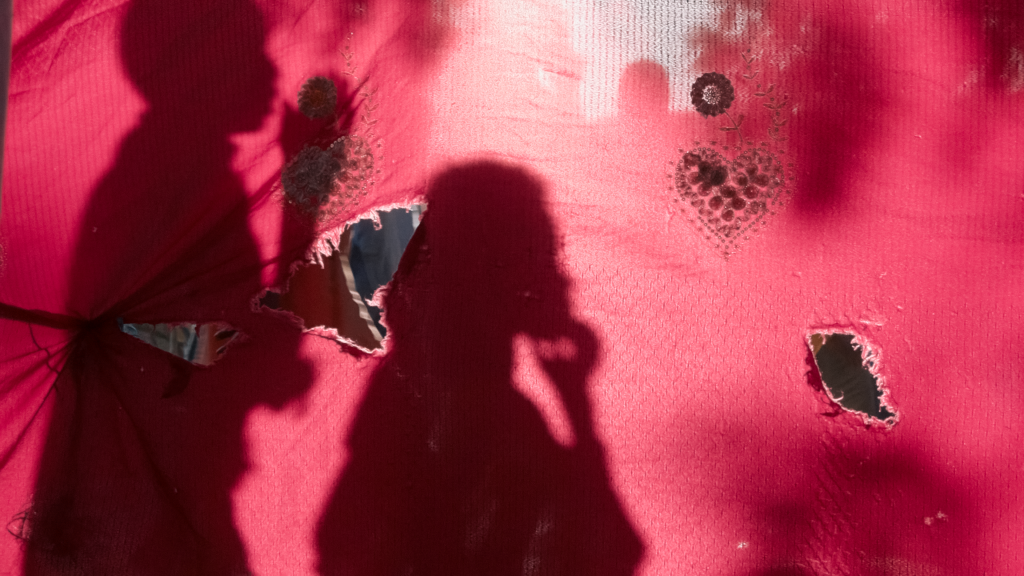
1 Still: Ruwahha li-lmahabba
Execution
I had previously conducted eight months of ethnographic fieldwork in Chad. To gain better insight into the Sahel-wide network and the life of Sheikh Ibrahim Niasse, who holds a near-prophetic status in Chad, I spent three weeks in Senegal with the help of the Catharina Halkes Fund. During my stay in Kaolack, where an annual ceremony took place with pilgrims from across the region, I conducted interviews, observed, and stayed with a grandson of Niasse himself. The knowledge I gained during this stay is indispensable for answering my research question. Through interviews with Niasse’s daughters and grandsons, I gained a clearer picture of the role Sheikh Ibrahim Niasse played in gender emancipation and anti-colonialist movements. Conversations with these renowned daughters and a new generation of female Quranic school teachers have given me insight into global connections, where faith is central to connecting people between America, Europe, and Africa. Additionally, through participatory observation, I learned more about the experience of Islam and how relationships play a central role in it.
Subsequently, I continued my journey to Chad, where I went to deepen my knowledge and relationships. During my stay in N’Djaména, Beinamar, and Tapol, I utilized interviews, informal conversations, and participatory observation in my work with a Fulani community. The stay made me realize that clashes over land rights, resource scarcity, and violent conditions create complex circumstances in the country and neighboring areas. This knowledge is important because violence by and against the Fulani in the region is only increasing. The fieldwork also taught me to be resilient as an anthropologist and to return to the Netherlands with an activist attitude. In addition to this in-depth research, I screened my first ethnographic film in Chad for the three women central to it and discussed it with them. Although I found it nerve-wracking to show this audiovisual creation, the academic film was well received by the women and their students. It was an honor for me to see the amazement in their eyes and to look back together on the research from a broader perspective—something I could never have done without this intensive collaboration. The women gave their consent to create a final version and subsequently publish and distribute it. During the screening, there was room for discussion, but I soon noticed that a discussion like the ones I am accustomed to at the university or in the Netherlands did not work. An informal exchange worked better, and I hope to reflect further on the details of this production process in my dissertation. A screening for anthropologists, the Dutch ambassador, historians, and journalists provided me with a great deal of substantive and technical feedback, with which I returned to the Netherlands satisfied.
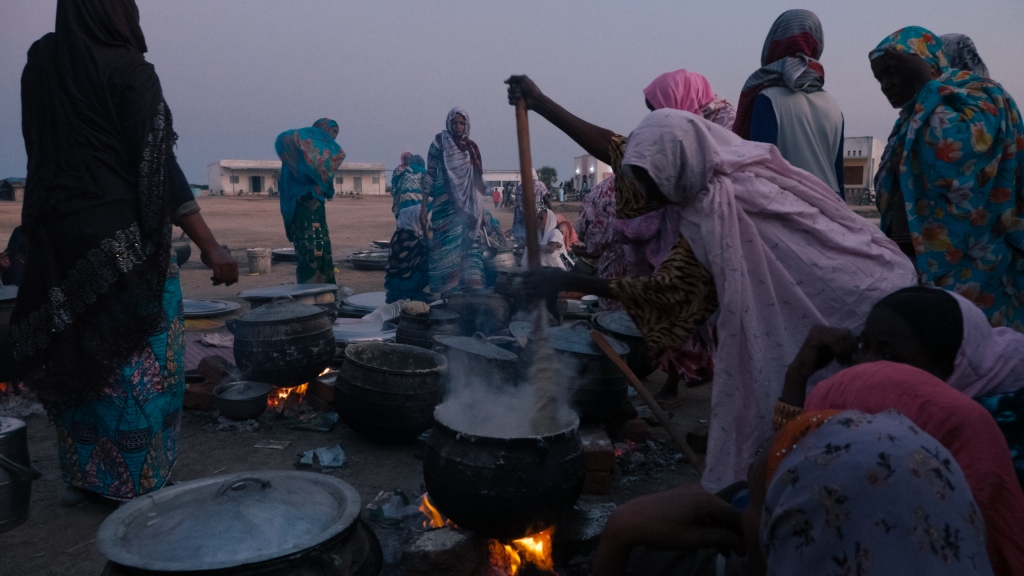
2 Still: Ruwahha li-lmahabba
Upon my return, I continued the production process with editor Jilles van Kleef. We showed a second version to a select group of people again, and incorporated that feedback. In the final months (May, June), a graphic designer and sound engineer elevated the film to an even higher level. What remains now is distribution.
Transferability
The film’s shared mission is to make stories about Islam and the profession of faith resonate emotionally with both Western and non-Western audiences by submitting it to film festivals. A small portion of the budget awarded by the Catharina Halkes Fund remains to submit the film to a festival and organize a local screening. An interview with the Leiden University magazine *Mare* is scheduled. Within universities, I hope to use the film as a starting point for further discussions on experimental methodology and ethics, for the purpose of broadening education and research on Islam and Africa by non-Muslims and white people.