Last week, Matthew travelled to Lausanne, Switzerland to attended the International Conference on Language Variation in Europe (ICLaVE). The conference theme this year is “Language, Im/mobility, Belonging”, which very much fits our analysis on the texts and images from the Facebook analysis. Many scholars who work on sociolinguistics, dialectology and other branches of linguistics also attended this conference. It was a great opportunity to hear what the state-of-the-art approaches in analysing language, which is very relavant to our research in processing language data from social media.
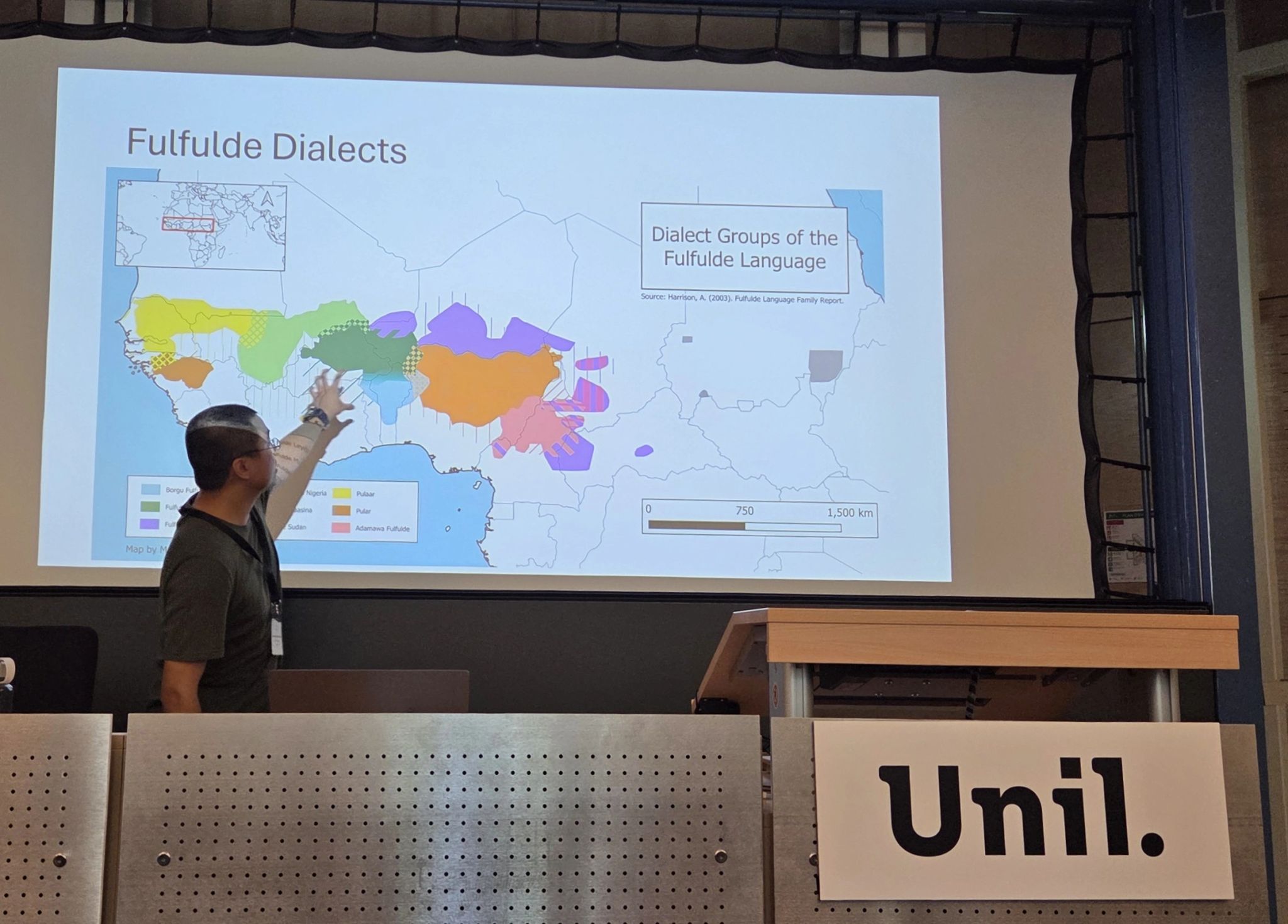
We first gave the audience some language background about Fulfulde, then we went deeper into our analysis on Fulani and identity in our social media data. We got many interests in our project, especially in the use of the multi-modal approach (NLP combined with image processing). Matthew even had to dig out slides from another presentation to show the technical details for how we identify topics in our Facebook image dataset (as requested by the audience)! We also got questions about the use of language in the Facebook posts, as well as some difficulties which we have encountered when working with social media data.
On the last day of the conference, here was also a session “New Perspectives on Lexical Variation”. During the discussion, some scholars have proposed to perhaps use social media data as a future source for looking at (lexical) variation. Matthew has raised the issue that if one wishes to do so, one should act as quickly as they can, since while we were compiling our data, we realised that data produced further back start to disappear – the more further back the data, the more incomplete they are. Our research, although not directly linked to lexical variation, can also make contributions to linguistic studies!
It was a very nice 3-day conference to attend.
Here is our abstract:
“”Language is not only a tool for communication but also a key marker of identity, shaping how individuals and communities define themselves and relate to others. At the individual level, language enables self-expression and the construction of identity. On a collective scale, it functions as a powerful symbol of shared belonging, while also serving as a site of ideological contestation over inclusion and exclusion (Edwards, 2009). In multilingual regions such as the Sahel, language practices are fluid and dynamic, reflecting shifting affiliations, social hierarchies, and transnational connections (Lüpke and Storch, 2013). The Sahel, a vast belt stretching from Senegal and Mauritania in the west to Sudan and Eritrea in the east, is home to exceptional linguistic diversity, with languages from the Niger-Congo, Afro-Asiatic, and Nilo-Saharan families coexisting alongside languages such as French, Arabic, and English.
Earlier studies often described this diversity through functional distinctions—contrasting, for instance, “official” and “local” languages, or formal and informal domains of use. While such models offer valuable insight, they tend to overlook the dynamic, creative ways in which speakers combine linguistic resources to express identity, solidarity, and difference. More recent work has therefore emphasized multilingualism as a lived and negotiated practice, shaped by social relations, mobility, and technological change (Mc Laughlin, 2021).
Our study builds on this perspective by examining language use among Fulfulde-speaking communities on Facebook. The Fulbe (also known as Peul or Fula) are a transnational people spread across the Sahel and beyond, without a single nation-state anchoring their collective identity. Their long history of mobility—through pastoralism, trade, education, and migration—has fostered high levels of multilingualism and rich dialectal variation within Fulfulde itself. Drawing on a corpus of 120 Facebook pages created and managed by Fulbe communities, we explore how digital platforms serve as spaces for identity construction, community interaction, and cultural expression. The administrators of these pages are based in diverse locations across the Sahel, as well as in Europe and the United States, reflecting both the regional reach and the global diaspora of the Fulbe.
We approach this material through questions central to digital sociolinguistics and identity research:
• In-group vs. out-group expression: How does the use (or non-use) of Fulfulde mark inclusion within or distance from Fulbe identity?
• Audience design: To what extent do page administrators and contributors adjust their language choice—using French, English, or Fulfulde—according to their intended audiences, whether local, regional, or diasporic?
• Linguistic hybridity: How do practices of code-switching and code-mixing function to express solidarity, humor, or political stance?
• Thematic focus: How are cultural identity and discussions of violence and stigmatization linguistically framed across languages and varieties?
By addressing these questions, we aim to understand how Fulfulde-speaking communities use Facebook as a kind of digital homeland—a space where language serves both as a resource for reaffirming shared identity and as a site for negotiating multiple, overlapping forms of belonging. More broadly, the study contributes to discussions on multilingualism, digital communication, and transnational identity in contemporary Africa.””
There were many interests in our image analysis especially, and of course, interests in the language aspects, like “Is there language mixing present on Facebook?”.