Ruben Edel
Pour le français, voir ci-dessous
Experiencing a Coup from Afar
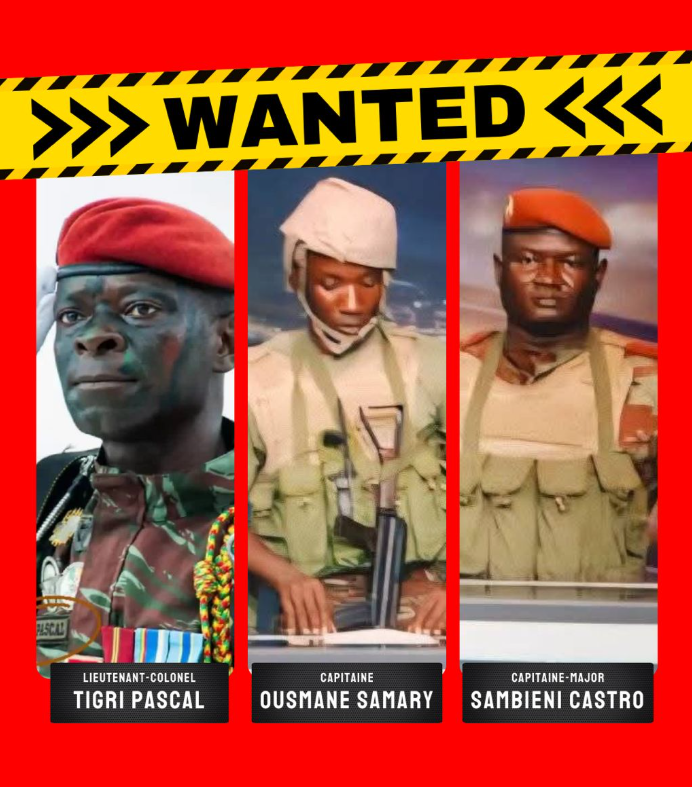
It is the 7th of December 2025. I have been preparing my research project in Benin for several months and am scheduled to leave in about a month. It is early in the morning when a breaking news notification flashes on my phone. Al Jazeera: “Coup d’état attempt in Benin.” Before I can fully process it, other alerts begin to appear on my phone: headlines, updates and videos, one after another. Almost immediately, I open multiple news outlets, both local and international, hoping to find clarification. Yet little information is available. Reports are brief, repetitive and fail to fully describe the situation. There are no details and no confirmations, so instead I turn to social media. I move from Facebook to TikTok, from Instagram to X, searching for that extra piece of information that could definitively explain what is actually going on.
Instead, I encounter chaos. Narratives multiply rapidly and contradict each other entirely. Some posts dismiss the coup as a complete deception. Others announce that it has already succeeded. Some claim the president is safe and under protection; others insist he has been captured, or even killed. The stream of updates is continuous, each telling a different truth. For several hours, I linger in confusion. I worry about people in Benin and those I have been in contact with, as well as the implications for my research project. During these hours, all I do is scroll and refresh, trying desperately to find the newest information that could tell me what is actually happening. But the constant flow of information does not relieve the uncertainty; it only worsens it.
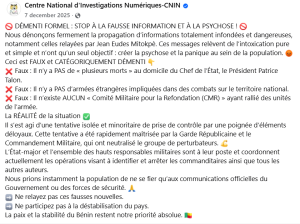
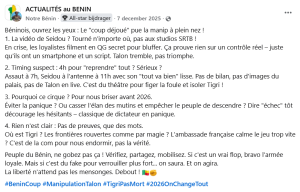
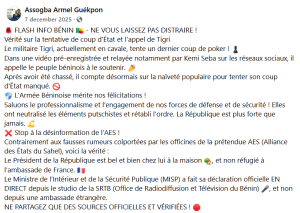
Only after half a day does the smoke begin to clear. Gradually, one narrative becomes the most dominant: the coup attempt appears to have failed, and the situation seems to be under control. Not long after, the president delivers a televised speech, officially confirming that this is indeed the case. I stop refreshing social media feeds obsessively, feeling relieved but also puzzled. During those first hours after the coup attempt, so many conflicting narratives circulated online that making sense of the situation felt nearly impossible. How is it possible that such an abundance of information could result in so much confusion? And what must it have been like for the nearly 780,000 people actually living in Cotonou, experiencing this moment not from afar, but from within the city itself?
Perceptions and Uncertainty in Cotonou
A month later, I have the opportunity to ask some people about that day. I have arrived in Cotonou, where I will be staying for a couple weeks to conduct some orienting interviews before continuing my journey to Parakou. While the city is chaotic, with the characteristic Zémidjans (motorbike taxis) constantly engulfing the streets with the sound of claxons and the smell of exhaust fumes, it also seems peaceful. It has been approximately six weeks since the coup attempts, and it is hard to imagine that these streets were once filled with gunfire and the sky with military jets.
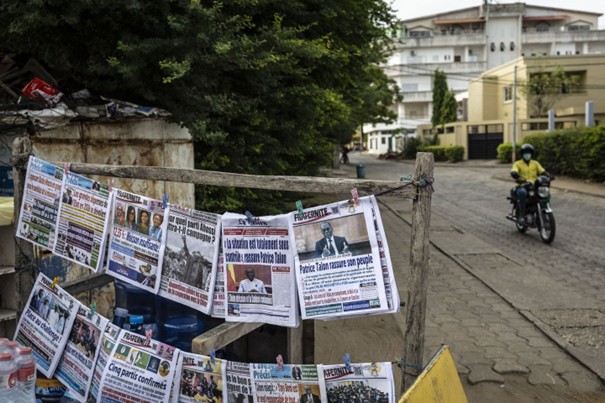
During my interviews, I ask young Beninese about how they experienced the morning of the coup attempt. James (pseudonym) (27), recalls: “First, I heard about the coup on TikTok. I was scrolling and I saw a video. In my head, I thought, ‘This is not Benin.’” Like many others, he first received the news about the coup attempt on social media feeds. “There was so much misinformation. A lot of people lied, some even said the president had been killed!”. Another interviewee, Fayola (pseudonym) (23), describes the witnessing of those different narratives on Facebook: “Some people said it failed, while others said it didn’t. It was not clear… We needed to know if we could go out or not. Only when we saw that the president was going to speak on TV did we understand that everything was okay.”
I also spoke to Maurice Tanthan, an expert on Beninese social media and disinformation. During our interview, he goes even further about the role of social media on that fateful day: “”In the case of the coup attempt, the spread of fake news was, in my view as a specialist, almost part of the coup itself. When information is not immediately controlled by official authorities, people can say anything online.” He explains how social media can be ‘weaponized’, and how the distribution of false narratives can help to destabilize a government. These narratives, he argues, can obscure clarity and create confusion, a strategy employed not solely by Beninese actors: “Much of this content actually came from neighbouring countries, such as Niger or Burkina Faso, from actors who wanted to destabilize the regime in Cotonou.”
The Fog of Social Media
The events of 7 December 2025 were experienced in a similar way by young Beninese as those watching from afar. Overwhelmed by the sudden news, we all turned to social media to make sense of what was occurring, hoping for some clarity. But instead of clarity, the social media feeds caused confusion, anxiety and disorientation. Information on social media moves fast, way faster than traditional media outlets, and its horizontal information flows allow for a space where information is produced and consumed at simultaneously. On that morning, the constant flow of conflicting narratives, rumours and disinformation created uncertainty not because information was absent, but because it was abundant.
This dynamic reflects what Stupart & Ahmed (2025) describe as ‘Mediatization of Conflict’. Social media did not simply report on the attempt, but its discourse actively shaped how it was perceived. Different narratives circulated simultaneously, as posts, videos and truths moved faster than verification could keep up. Among young Beninese, this resulted in feelings of confusion and uncertainty, generating a “fog of social media”, similar to the military term of a “fog of war”, where clarity is lost due to rapidly unfolding events. This ‘fog of social media’ did not only obscure the events of the coup, they resulted in a reshaping of how the political crisis was perceived. In a landscape where everyone can post, comment and share, new truths are constantly emerging and evolving.
And while the streets of Cotonou may seem calm, the memory of the coup attempt continues to live on through Beninese social media. Although it is now clear what occurred on that day, people continue to share their perspectives and debate what happened, shaping how others understand those events. It serves as a powerful reminder of the role of social media in times of political crisis. Social media platforms are far from neutral, but are active spaces where truths are circulated, contested and transformed.
Bibliography:
Stupart, R. & Ahmed, H. (2025): The Mediatization of Conflict: Critical Reflections on Center-Periphery Constructions in the Media. The Rowman & Littlefield Handbook of Peace and Conflict Studies
Vivre un coup d’État à distance
Nous sommes le 7 décembre 2025. Je prépare mon projet de recherche au Bénin depuis plusieurs mois et je dois partir dans environ un mois. Il est tôt le matin lorsqu’une notification d’actualité urgente s’affiche sur mon téléphone. Al Jazeera : « Tentative de coup d’État au Bénin ». Avant même que je puisse pleinement comprendre ce qui se passe, d’autres alertes commencent à apparaître sur mon téléphone : titres, mises à jour et vidéos, les uns après les autres. Presque immédiatement, j’ouvre plusieurs sites d’information, locaux et internationaux, dans l’espoir de trouver des éclaircissements. Mais peu d’informations sont disponibles. Les reportages sont brefs, répétitifs et ne décrivent pas pleinement la situation. Il n’y a ni détails ni confirmations, je me tourne donc vers les réseaux sociaux. Je passe de Facebook à TikTok, d’Instagram à X, à la recherche d’informations supplémentaires qui pourraient expliquer de manière définitive ce qui se passe réellement.
Au lieu de cela, je suis confrontée au chaos. Les récits se multiplient rapidement et se contredisent totalement. Certains messages rejettent le coup d’État comme étant une supercherie totale. D’autres annoncent qu’il a déjà réussi. Certains affirment que le président est en sécurité et sous protection ; d’autres insistent sur le fait qu’il a été capturé, voire tué. Les mises à jour se succèdent sans discontinuer, chacune racontant une vérité différente. Pendant plusieurs heures, je reste dans la confusion. Je m’inquiète pour les habitants du Bénin et les personnes avec lesquelles j’ai été en contact, ainsi que pour les implications pour mon projet de recherche. Pendant ces heures, je ne fais que faire défiler et actualiser les pages, essayant désespérément de trouver les dernières informations qui pourraient m’indiquer ce qui se passe réellement. Mais le flux constant d’informations ne dissipe pas l’incertitude, il ne fait que l’aggraver.
Ce n’est qu’au bout d’une demi-journée que la fumée commence à se dissiper. Peu à peu, un récit s’impose : la tentative de coup d’État semble avoir échoué et la situation semble être sous contrôle. Peu après, le président prononce un discours télévisé, confirmant officiellement que c’est bien le cas. Je cesse de rafraîchir obsessionnellement les fils d’actualité des réseaux sociaux, soulagée mais aussi perplexe. Au cours des premières heures qui ont suivi la tentative de coup d’État, tant de versions contradictoires ont circulé en ligne qu’il semblait presque impossible de comprendre la situation. Comment une telle abondance d’informations a-t-elle pu entraîner une telle confusion ? Et comment ont dû se sentir les quelque 780 000 personnes qui vivent à Cotonou et qui ont vécu ce moment non pas de loin, mais depuis la ville même ?
Perceptions et incertitudes à Cotonou
Un mois plus tard, j’ai l’occasion d’interroger certaines personnes au sujet de cette journée. Je suis arrivé à Cotonou, où je vais rester quelques semaines pour mener des entretiens d’orientation avant de poursuivre mon voyage vers Parakou. Si la ville est chaotique, avec ses zémidjans (motos-taxis) caractéristiques qui envahissent constamment les rues avec le bruit des klaxons et l’odeur des gaz d’échappement, elle semble également paisible. Cela fait environ six semaines que les tentatives de coup d’État ont eu lieu, et il est difficile d’imaginer que ces rues étaient autrefois remplies de coups de feu et que le ciel était envahi par des avions militaires.
Au cours de mes entretiens, j’interroge des jeunes Béninois sur la façon dont ils ont vécu la matinée du coup d’État. James (pseudonyme), 27 ans, se souvient : « J’ai d’abord entendu parler du coup d’État sur TikTok. Je faisais défiler mon fil d’actualité et j’ai vu une vidéo. Je me suis dit : « Ce n’est pas le Bénin. » » Comme beaucoup d’autres, c’est sur les réseaux sociaux qu’il a appris la nouvelle de la tentative de coup d’État. « Il y avait tellement de désinformation. Beaucoup de gens ont menti, certains ont même dit que le président avait été tué ! ». Une autre personne interrogée, Fayola (pseudonyme) (23 ans), décrit les différents récits qu’elle a vus sur Facebook : « Certaines personnes disaient que ça avait échoué, d’autres disaient que non. Ce n’était pas clair… Nous avions besoin de savoir si nous pouvions sortir ou non. Ce n’est que lorsque nous avons vu que le président allait s’exprimer à la télévision que nous avons compris que tout allait bien. »
J’ai également discuté avec Maurice Tanthan, expert des réseaux sociaux et de la désinformation au Bénin. Au cours de notre entretien, il va encore plus loin sur le rôle des réseaux sociaux lors de cette journée fatidique : « Dans le cas de la tentative de coup d’État, la propagation de fausses informations faisait, à mon avis en tant que spécialiste, presque partie intégrante du coup d’État lui-même. Lorsque les informations ne sont pas immédiatement contrôlées par les autorités officielles, les gens peuvent dire n’importe quoi en ligne. » Il explique comment les réseaux sociaux peuvent être « utilisés comme une arme » et comment la diffusion de fausses informations peut contribuer à déstabiliser un gouvernement. Selon lui, ces informations peuvent brouiller les pistes et semer la confusion, une stratégie qui n’est pas uniquement employée par des acteurs béninois : « Une grande partie de ce contenu provenait en fait de pays voisins, tels que le Niger ou le Burkina Faso, et d’acteurs qui voulaient déstabiliser le régime à Cotonou. »
Le brouillard des réseaux sociaux
Les événements du 7 décembre 2025 ont été vécus de la même manière par les jeunes Béninois que par ceux qui les observaient de loin. Submergés par cette nouvelle soudaine, nous nous sommes tous tournés vers les réseaux sociaux pour comprendre ce qui se passait, dans l’espoir d’y trouver des éclaircissements. Mais au lieu de clarifier les choses, les flux des réseaux sociaux ont semé la confusion, l’anxiété et la désorientation. L’information circule rapidement sur les réseaux sociaux, bien plus rapidement que dans les médias traditionnels, et ses flux horizontaux permettent de produire et de consommer l’information simultanément. Ce matin-là, le flux constant de récits contradictoires, de rumeurs et de désinformation a créé de l’incertitude, non pas parce que l’information était absente, mais parce qu’elle était abondante.
Cette dynamique reflète ce que Stupart & Ahmed (2025) décrivent comme la « médiatisation du conflit ». Les réseaux sociaux n’ont pas simplement rendu compte de la tentative, mais leur discours a activement façonné la façon dont elle a été perçue. Différents récits ont circulé simultanément, les publications, les vidéos et les vérités se déplaçant plus vite que la vérification ne pouvait suivre. Chez les jeunes Béninois, cela a suscité un sentiment de confusion et d’incertitude, générant un « brouillard des réseaux sociaux », similaire au terme militaire de « brouillard de guerre », où la clarté est perdue en raison de l’évolution rapide des événements. Ce « brouillard des réseaux sociaux » n’a pas seulement obscurci les événements du coup d’État, il a également remodelé la perception de la crise politique. Dans un paysage où tout le monde peut publier, commenter et partager, de nouvelles vérités émergent et évoluent constamment.
Et si les rues de Cotonou semblent calmes, le souvenir de la tentative de coup d’État continue de vivre à travers les réseaux sociaux béninois. Bien que l’on sache désormais clairement ce qui s’est passé ce jour-là, les gens continuent de partager leurs points de vue et de débattre de ce qui s’est passé, influençant ainsi la façon dont les autres comprennent ces événements. Cela nous rappelle avec force le rôle des réseaux sociaux en période de crise politique. Les plateformes de réseaux sociaux sont loin d’être neutres, mais constituent des espaces actifs où les vérités circulent, sont contestées et transformées.
Bibliographie:
Stupart, R. & Ahmed, H. (2025): The Mediatization of Conflict: Critical Reflections on Center-Periphery Constructions in the Media. The Rowman & Littlefield Handbook of Peace and Conflict Studies